 TutorialKart.com
What is SAP PS (Project Systems) Module
SAP Project System, commonly written as SAP PS or SAP Project Systems, is the SAP module used to plan, structure, budget, execute, monitor, and close projects. It helps project teams break a project into manageable parts, assign dates and resources, collect costs and revenues, procure materials, and integrate project data with finance, logistics, sales, production, maintenance, and human resources.
SAP PS is useful when an organization manages work as a project rather than as a simple transaction. Examples include construction projects, plant maintenance shutdowns, capital investment projects, customer implementation projects, research projects, and large internal initiatives. The module can support small internal projects as well as complex projects with multiple departments, budgets, milestones, and settlement rules.
- SAP PS meaning and purpose
- What SAP Project System does
- SAP PS integration with other modules
- SAP Project System components
- Organizational structure in SAP PS
- Project phases in SAP PS
- Simple SAP PS business example
- SAP PS module FAQs
SAP PS meaning in project planning and control
SAP PS stands for SAP Project System. It is an integrated project management module in SAP ERP and SAP S/4HANA landscapes. The module helps an organization define the project structure first, then use that structure for planning dates, costs, budgets, resources, materials, procurement, confirmations, billing, settlement, and reporting.
The key idea in SAP PS is that a project should not be tracked as one large block of work. It is divided into clear structural elements, mainly Work Breakdown Structure elements and, where required, network activities. This makes it easier to assign responsibility, monitor progress, control budgets, and understand where project cost or delay is coming from.
What exactly SAP Project System does
SAP PS helps in planning, controlling and collects cost and revenues through structures (WBS). The important functionality of SAP PS module is to manage all stages of project very efficiently from planning stage to completion stage.
In practical SAP usage, SAP PS supports the following project management activities:
- Project structuring: Create a project definition, WBS elements, networks, activities, milestones, and relationships.
- Date planning: Maintain planned dates and scheduling logic for project activities and milestones.
- Cost planning: Estimate planned costs at WBS or activity level and compare them with actual costs.
- Budget control: Assign budgets and control project spending through availability control where configured.
- Resource planning: Plan internal labor, external services, machines, and other resources needed for project execution.
- Material planning: Link project activities with material requirements, procurement, reservations, and stock where relevant.
- Revenue and billing support: Integrate with sales and billing processes for customer projects.
- Settlement and closing: Settle project costs to assets, cost centers, profitability segments, or other receivers based on business rules.
- Project reporting: Track planned cost, actual cost, commitments, remaining work, dates, milestones, and project status.
For official product documentation, refer to the SAP Project System help documentation.
SAP PS integration with SAP FICO, MM, SD, PP, PM and HCM
SAP PS module is fully integrated with other SAP R/3 modules such as SAP HCM (Human Capital Management), SAP SD (Sales & Distribution), SAP PP (Production Planning), SAP PM (Plant Maintenance), SAP FICO (Financial Accounting), SAP IM (Investment Management), SAP MM (Material Management) and with various SAP R/3 applications. The integration of PS with other modules enables to plan and execute all the tasks associated with a project. Through integration ,PS module can access the data from the departments involved in a project and provides consistent real time data.
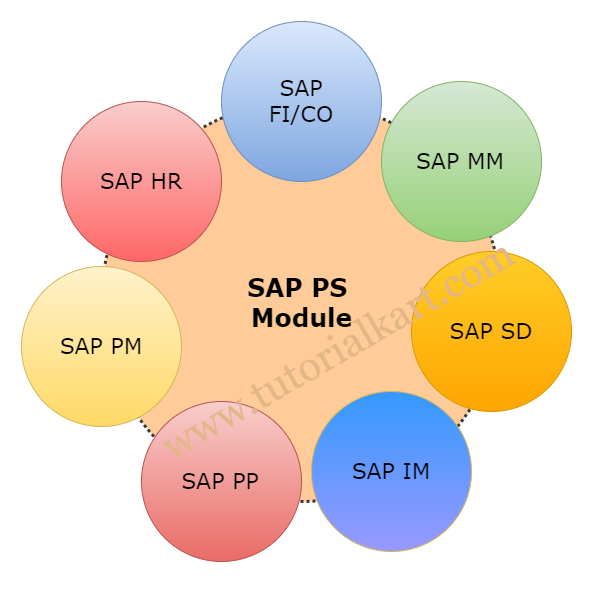
The integration is important because project work usually creates financial, material, procurement, sales, and resource transactions. SAP PS provides the project structure, while other modules provide the business execution data.
| SAP module integrated with SAP PS | How the integration helps a project |
|---|---|
| SAP FICO | Posts actual costs, budgets, commitments, settlements, and financial reporting values for project objects. |
| SAP MM | Supports project-related purchasing, material requirements, purchase requisitions, purchase orders, and goods movements. |
| SAP SD | Supports customer projects, sales orders, billing plans, revenues, and project-related customer billing. |
| SAP PP | Connects production-related project requirements with planning and manufacturing processes. |
| SAP PM | Connects maintenance projects, shutdown projects, and technical work with maintenance orders and equipment data. |
| SAP HCM | Supports workforce and time-related project processes when integrated with personnel and activity confirmation data. |
| SAP IM | Links large investment projects with investment programs and capital budgeting processes. |
SAP Project System components used in project control
The important components of SAP project systems module are
- Structures
- Cost
- Dates
- Resources
- Materials – MRP, BOM
- Project Versions
The following table explains how these components are used in SAP PS project execution.
| SAP PS component | Purpose in the project |
|---|---|
| Project Definition | Top-level object that identifies the project and stores basic control information. |
| WBS Element | Breaks the project into deliverables or responsibility areas for planning, budgeting, and reporting. |
| Network | Represents the flow of project activities and helps in scheduling and execution control. |
| Activity | Represents work to be performed, such as internal labor, external service, material activity, or cost activity. |
| Milestone | Marks important project events such as design approval, procurement completion, testing, or handover. |
| Cost planning | Stores expected project costs so that planned cost can be compared with actual cost. |
| Budgeting | Controls how much money can be consumed by the project when availability control is configured. |
| Project versions | Capture a snapshot of project planning data for comparison and audit purposes. |
Organizational structure of Project System in SAP
The SAP PS module does not have its own organizational structure, and it uses organizational units of logistics and accounting by means of assignment.
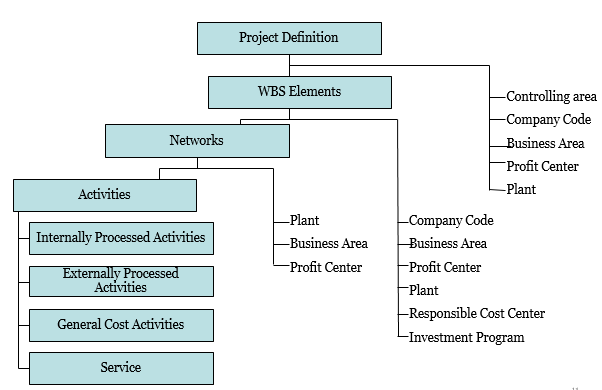
This means SAP PS objects are assigned to controlling areas, company codes, business areas, plants, profit centers, cost centers, sales organizations, and other organizational units depending on the scenario. These assignments allow project transactions to flow into finance, controlling, procurement, sales, and logistics reporting.
Project phases in SAP PS from planning to closure
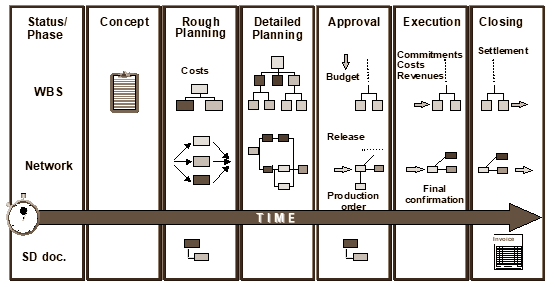
A project in SAP PS usually passes through a controlled lifecycle. The exact process differs by industry and configuration, but the common project phases are:
- Project creation: Create the project definition and initial WBS structure.
- Planning: Plan dates, costs, resources, milestones, materials, and budgets.
- Approval and release: Release the project or relevant WBS elements so execution transactions can begin.
- Execution: Record actual costs, confirmations, procurement, goods movements, service entries, and progress.
- Monitoring: Compare planned cost, budget, actual cost, commitments, dates, and project status.
- Settlement: Settle project costs to the correct receivers such as assets, cost centers, or profitability segments.
- Closure: Close completed project objects after final postings and checks are complete.
Simple SAP PS example for a construction project
Consider a company that is building a new warehouse. In SAP PS, the company may create one project definition called Warehouse Construction Project. Under it, the project manager can create WBS elements such as design, civil work, electrical work, equipment installation, testing, and handover.
Each WBS element can have planned cost, budget, responsible cost center, milestones, and settlement rules. Network activities can be used for tasks such as foundation work, steel installation, electrical wiring, safety inspection, and final commissioning. Materials can be procured through SAP MM, costs can post to SAP FICO, and billing or revenue can be integrated through SAP SD when the project is customer-facing.
SAP PS module learning path for beginners
A beginner learning SAP PS should first understand the project structure before learning configuration or transactions. Start with project definition, WBS elements, networks, activities, milestones, cost planning, budgeting, and settlement. Then study how SAP PS integrates with FICO, MM, SD, PM, PP, HCM, and IM.
- Learn why a project definition is created.
- Understand how WBS elements represent project deliverables and responsibility areas.
- Learn when networks and activities are required.
- Understand how planned cost, actual cost, commitment, and budget differ.
- Study how procurement and material requirements are generated from project activities.
- Learn project settlement and why costs must be settled at period-end or project close.
Continue to read our SAP PS tutorial that explains step by step with real time project scenarios.
SAP PS consultant role and project responsibilities
An SAP PS consultant generally works with project managers, finance teams, procurement teams, maintenance teams, sales teams, and technical teams to design project processes in SAP. The responsibilities may include gathering requirements, configuring project profiles and structures, supporting budgeting and settlement, testing integration flows, preparing training material, and helping users resolve project execution issues.
Career demand and salary for SAP PS vary by country, industry, SAP version, project complexity, and consultant experience. For career planning, use current job postings and regional salary data rather than a fixed number from a general tutorial.
SAP PS module QA checklist for editorial review
- Confirm the article uses the correct term SAP Project System while also covering the common search phrase SAP Project Systems.
- Check that WBS elements, networks, activities, milestones, cost planning, budgeting, and settlement are explained separately.
- Verify that SAP PS integration is described with relevant modules such as FICO, MM, SD, PP, PM, HCM, and IM.
- Avoid giving unsupported salary numbers or demand claims without current regional data.
- Make sure project lifecycle content covers planning, release, execution, monitoring, settlement, and closure.
- Do not describe SAP PS as a standalone project management tool without explaining its integration with SAP business transactions.
SAP PS module FAQs
What is SAP Project Systems PS?
SAP Project System, often searched as SAP Project Systems or SAP PS, is the SAP module used to structure, plan, execute, monitor, and close projects. It supports WBS elements, networks, activities, milestones, costs, budgets, materials, and settlement.
What are SAP PS modules used for in business projects?
SAP PS is used for projects that need controlled planning and cost tracking, such as construction, capital investment, plant maintenance, customer implementation, engineering, and internal development projects.
How does SAP PS integrate with SAP FICO and SAP MM?
SAP PS integrates with SAP FICO for costs, budgets, commitments, settlements, and financial reporting. It integrates with SAP MM for project-related purchasing, material requirements, purchase orders, goods movements, and service procurement.
Is SAP PS in demand?
SAP PS skills are relevant in organizations that run project-heavy processes, especially where projects involve finance, procurement, materials, assets, sales, or maintenance. Demand depends on region, industry, SAP landscape, and current hiring needs.
What is the salary of an SAP PS consultant?
SAP PS consultant salary varies by country, experience, company, project type, SAP S/4HANA exposure, and integration knowledge. Use current regional salary sources and active job postings for a realistic estimate.
SAP PS module overview: key points to remember
SAP PS is used to manage project structures, costs, dates, resources, materials, budgets, and settlements inside an integrated SAP system. Its main strength is not only project planning, but also the connection between project work and real business transactions in finance, procurement, sales, production, maintenance, and human resources.