 TutorialKart.com
In this SAP tutorial, you will learn how to define accounting principles in SAP FI and assign accounting principles to ledger groups. Accounting principles are used in parallel accounting so that financial data can be reported according to different reporting rules, such as local GAAP, group accounting, or IFRS, depending on the design of your SAP system. In the previous tutorial, we learned how to configure foreign currency valuation method in SAP.
Note: – You can use predefined accounting principle that was provided by SAP or you can define your own principles as per your requirements. In a project system, the accounting principle key should be created only after the reporting requirement and ledger design are clear.
SAP accounting principle meaning in FI parallel accounting
An accounting principle in SAP represents the accounting rule or reporting basis used to prepare financial statements. It helps SAP identify which reporting view should be applied when postings, valuations, and financial reports are handled under parallel accounting.
For example, a company may need one reporting view for local statutory accounting and another reporting view for group reporting. In SAP FI, the accounting principle is linked with ledger groups so that transactions and valuations can be processed and reported under the correct accounting rule.
Where accounting principles are used in SAP FI
Accounting principles are commonly used in SAP FI configuration areas that support parallel accounting and period-end processing. They are especially relevant when a company maintains more than one reporting basis.
- Parallel accounting: Assign accounting principles to ledger groups so that reporting can be separated by accounting rule.
- Foreign currency valuation: Use accounting principles along with valuation areas and valuation methods during closing activities.
- Financial reporting: Support separate reporting views for local and group accounting requirements.
- Ledger-specific configuration: Connect accounting rules with the ledger groups used in General Ledger Accounting.
Before you define accounting principles in SAP FI
Before creating a new accounting principle, review the ledger setup and reporting requirement. This helps avoid creating duplicate or unclear accounting principle keys.
- Confirm whether the reporting requirement is for local GAAP, group reporting, IFRS, or another accounting basis.
- Check whether SAP already provides a suitable predefined accounting principle.
- Confirm the ledger group that will be assigned to the accounting principle.
- Use a short, meaningful key and description that can be understood during later configuration and testing.
- Coordinate the setting with related SAP FI activities such as valuation areas, foreign currency valuation, and ledger configuration.
Define accounting principles in SAP using SPRO
You can maintain accounting principles in SAP FICO by using the following navigation method.
- Transaction code: – SPRO
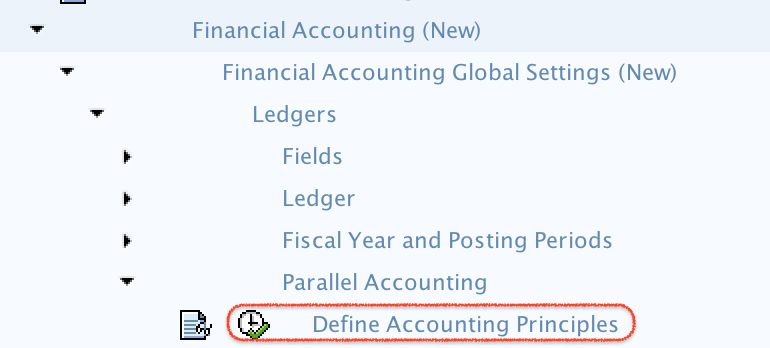
- SAP IMG –> Financial Accounting (New) –> General Ledger accounting (New)–> Financial Accounting Global Settings (New) –> Ledgers –> Parallel Accounting –> Define Accounting Principle.
Step 1) Follow the menu path and double click on “Define accounting principles”.
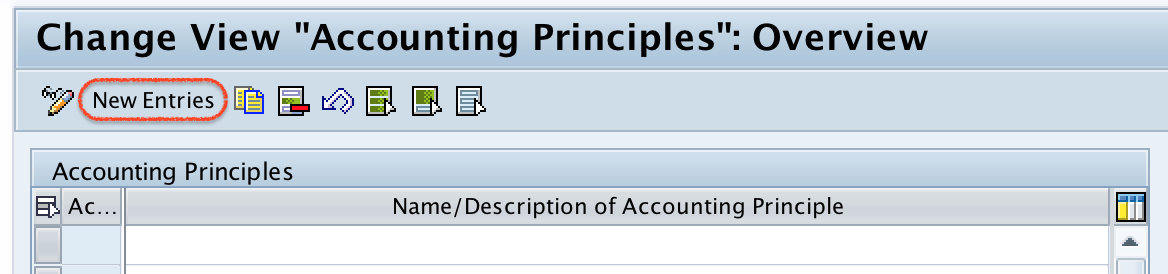
Step 2) On change view Accounting Principle overview screen, click on new entries button.
Step 3) On new entries screen, update the following details.
- Accounting Principle: – Enter the two-character key that identifies the accounting principle in SAP. Use a key that matches your project naming convention.
- Description: – Enter the descriptive text of accounting principles, such as Indian Accounting Standards, Local GAAP, Group Accounting, or IFRS, based on your business requirement.
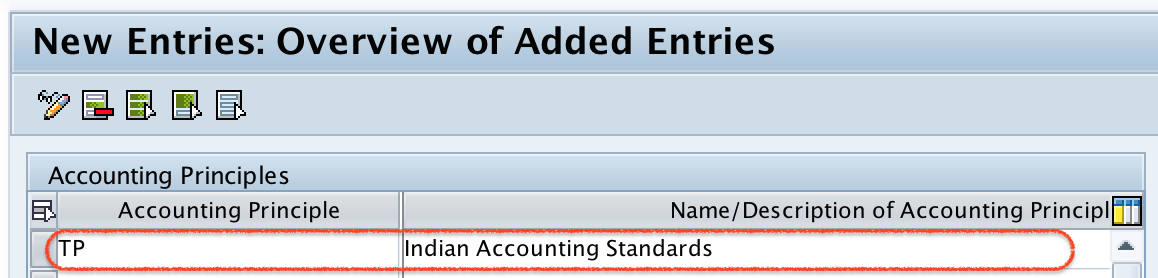
After maintaining all the required details, press enter and save in your request.
Accounting principle fields in SAP FI configuration
| Field | Purpose in SAP FI | Configuration note |
|---|---|---|
| Accounting Principle | Identifies the accounting rule used for reporting and parallel accounting. | Keep the key short and consistent. Avoid temporary names in a transportable configuration. |
| Description | Explains the reporting basis represented by the accounting principle. | Use a description that clearly tells whether the principle is local GAAP, group accounting, IFRS, or another reporting basis. |
| Ledger Group Assignment | Connects the accounting principle to the ledger group used for postings and reporting. | Assign only after the ledger group design is confirmed. |
Assign accounting principle to ledger groups in SAP FI
After configuration of accounting principles, you need it assign to the ledger groups. The assignment can be configured by using the following navigation.
- IMG Path: – Financial Accounting (New) –> General Ledger accounting (New)–> Financial Accounting Global Settings (New) –> Ledgers –> Parallel Accounting –> Assign Accounting Principle to Ledger Groups.
Step 1) Follow the above path and double click on IMG activity assign accounting principle to ledger groups.
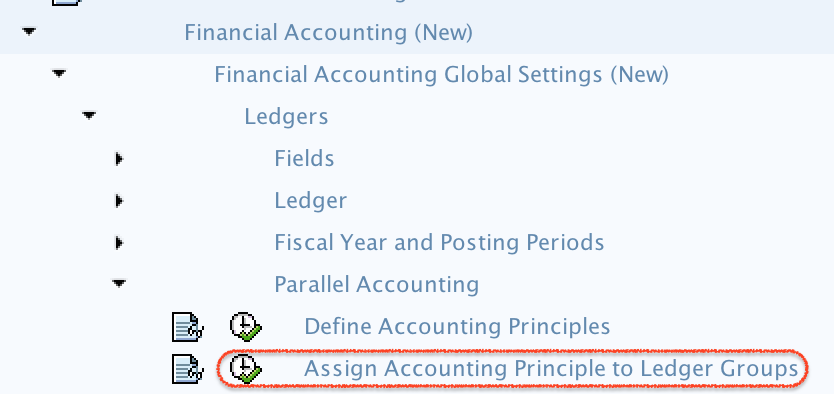
Step 2) on change view assignment of accounting principle to target ledger group screen, click on new entries button.

Step 3) On new entries screen, update the following details.
- Accounting Principle :- Update the accounting principle key for assignment.
- Ledger group – Update the ledger group key for assignment. The ledger group should match the reporting view represented by the accounting principle.
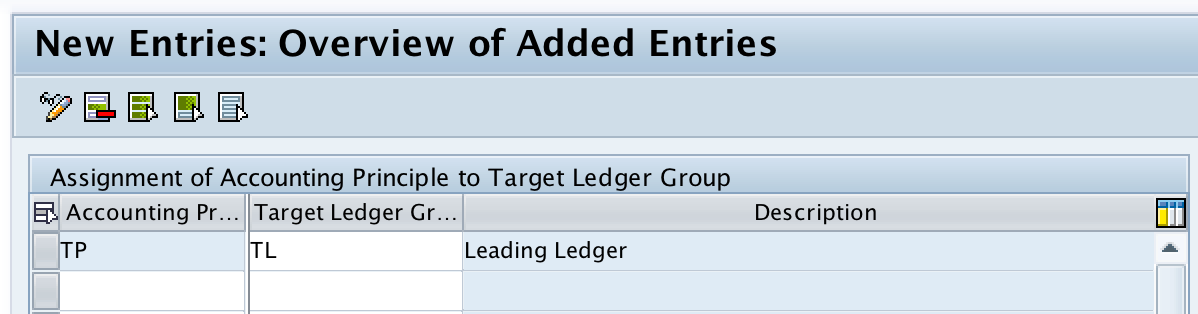
After maintaining the details, press enter and click on save button and save the configured details.
Successfully we have defined accounting principles and assigned to ledger group.
Accounting principle and ledger group difference in SAP FI
An accounting principle and a ledger group are related, but they do not mean the same thing. The accounting principle represents the accounting rule or reporting basis. The ledger group represents the ledger or group of ledgers to which the accounting principle is assigned.
In simple terms, the accounting principle answers the question, “Which accounting rule is being followed?” The ledger group answers the question, “Where should the related postings and reporting view be represented?” Both settings must be aligned for parallel accounting to work correctly.
Accounting principles with valuation areas in SAP FI closing
Accounting principles are also used with valuation-related settings in SAP FI. For example, when you define valuation areas and assign valuation areas to accounting principles, SAP can determine which valuation approach belongs to which accounting rule during closing.
After defining the accounting principle in this activity, the related follow-up configuration may include defining valuation areas in SAP FI, assigning valuation areas to accounting principles, and testing the period-end valuation run with the correct ledger and currency settings.
OB13 and OB58 are not accounting principle transactions
While learning this topic, users often compare accounting principle configuration with other SAP FI transactions. OB13 is used for chart of accounts configuration, and OB58 is used for financial statement version configuration. These settings are related to FI design, but they are not the same as defining accounting principles for parallel accounting.
Common mistakes when defining accounting principles in SAP FI
- Creating unclear accounting principle keys: A key without a clear naming standard is difficult to understand during later testing and support.
- Skipping the ledger group assignment: Defining the accounting principle alone is not enough when it must be used in parallel accounting.
- Assigning the wrong ledger group: The ledger group should match the reporting basis represented by the accounting principle.
- Using duplicate descriptions: Similar descriptions for multiple principles can confuse users during valuation and closing configuration.
- Changing configuration without checking dependent settings: Accounting principles may be used by valuation areas and other FI closing settings, so dependent configuration should be reviewed before making changes.
QA checklist for SAP accounting principle configuration
- Does the accounting principle key follow the project naming standard?
- Does the description clearly identify the reporting basis, such as local GAAP, IFRS, or group accounting?
- Has the correct ledger group been assigned to the accounting principle?
- Is the accounting principle aligned with valuation area and foreign currency valuation settings?
- Has the configuration been saved in the correct transport request and tested in the intended company code scenario?
SAP reference links for accounting principles and parallel accounting
For SAP product documentation on accounting principles and related General Ledger settings, refer to SAP Help for accounting principles in SAP S/4HANA and SAP Help for accounting principle configuration in SAP S/4HANA Cloud. Always validate the exact IMG path and available fields in your own SAP release because menu labels can vary between ECC, SAP S/4HANA, and SAP S/4HANA Cloud.
FAQs on accounting principles in SAP FI
What is the purpose of accounting principles in SAP FI?
Accounting principles in SAP FI define the accounting rule or reporting basis used in parallel accounting. They help connect reporting requirements such as local accounting, group accounting, or IFRS with the relevant ledger group.
How do you define accounting principles in SAP?
Go to SPRO and follow SAP IMG > Financial Accounting (New) > General Ledger Accounting (New) > Financial Accounting Global Settings (New) > Ledgers > Parallel Accounting > Define Accounting Principle. Choose New Entries, enter the accounting principle key and description, then save the configuration.
Why assign an accounting principle to a ledger group?
The assignment tells SAP which ledger group belongs to the accounting principle. This is required when postings, valuations, or reports need to be separated by reporting basis under parallel accounting.
What is OB13 in SAP?
OB13 is used for chart of accounts configuration in SAP FI. It is not the transaction for defining accounting principles, but it is part of the broader FI configuration landscape.
What is OB58 in SAP?
OB58 is used to define or maintain financial statement versions in SAP FI. It controls how financial statement items are structured for reporting and is different from accounting principle configuration.